Fading · Entry 06.3
The Grimeton exception
SAQ in Sweden, an Alexanderson alternator from 1924, still transmitting on 17.2 kHz at a wavelength that barely fades at all.
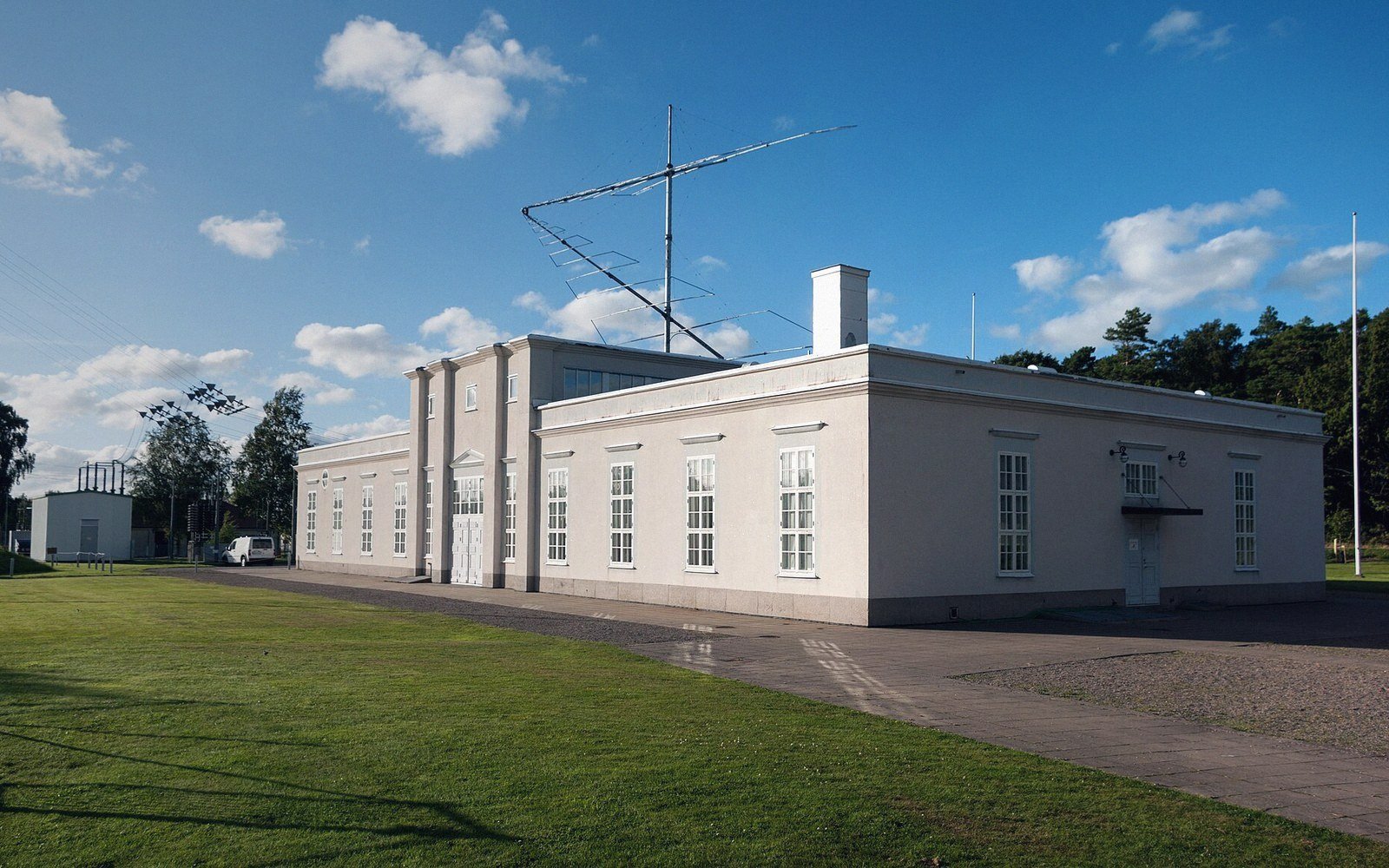
On a frequency so low that the ionosphere is almost irrelevant, a 1924 machine still makes its own rules.
Why 17.2 kHz plays by different physics
Most of what this site discusses — skywave skip, selective fading, the D-layer's daytime absorption, the licence conditions that change at sunset — rests on frequencies where the ionosphere is a genuine actor. Drop far enough below the AM broadcast band, and the ionosphere stops being an obstacle and becomes a mirror so reliable it barely needs watching.
Numbers that matter
Grimeton Radio Station, near Varberg in Sweden, transmits on 17.2 kHz. At that frequency the wavelength is roughly 17.4 kilometres — longer than most broadcasting towers are tall. The D layer, which absorbs medium-wave signals all day, can barely interact with energy at this scale; it passes through with very little loss. The lower ionosphere and the ground together guide it almost perfectly, day and night, with almost no variation between sunrise and sunset. The result is a signal that propagates around the Earth with extraordinary consistency, losing power predictably with distance rather than flickering with the ionosphere's mood.
The transmitter doing this is an Alexanderson alternator, designed by Ernst Alexanderson and installed in 1924. It generates radio waves the way a power station generates mains current: by spinning a slotted steel disc at enormous speed past magnetic pickups, producing an alternating current directly at the transmission frequency. There are no vacuum tubes, no transistors, no solid-state stages. The antenna system — six 127-metre steel masts supporting a fan of wires across the Swedish heathland — is itself a UNESCO World Heritage Site, protected because nothing like it is still operational anywhere else on Earth.

The station transmits as SAQ, typically on Alexanderson Day in late June and on other commemorative occasions. A receiver anywhere in Europe, and often well beyond, picks up a signal that has changed almost nothing since 1924, because at 17.2 kHz the atmosphere does not oscillate between co-operation and obstruction. The physics is simply slow, stable and indifferent to the time of day — which makes Grimeton almost the only transmitter on the planet that demonstrates what radio was like before fading became an engineering problem to be managed.