Modulation · Entry 05.1
Amplitude modulation
Encoding in the envelope, which is simple to detect and defenceless against noise that arrives the same way.
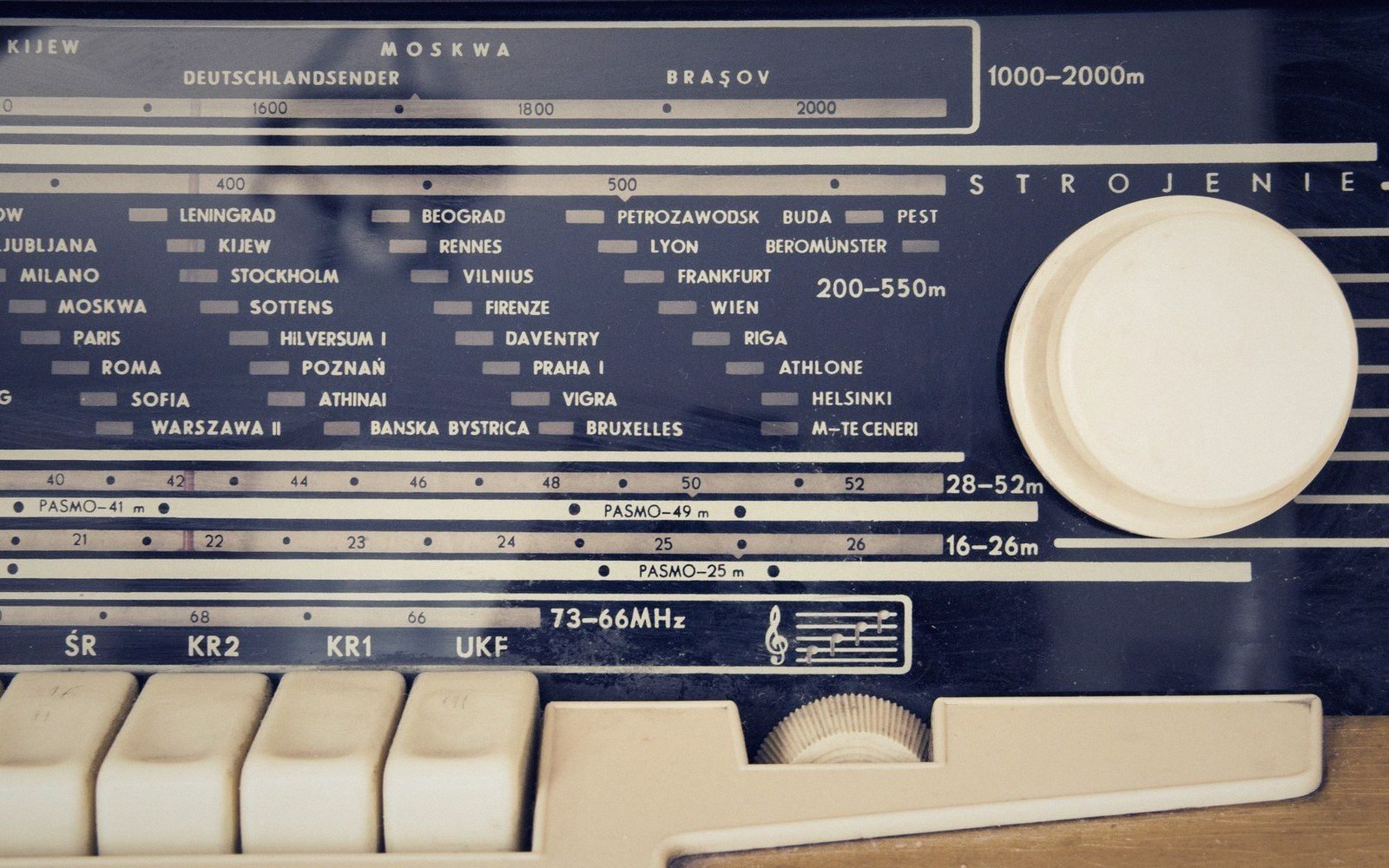
The carrier knows one trick — change its height — and every noise source in the atmosphere knows the same trick.
How the envelope carries the programme
A radio carrier is a steady sine wave, unchanging in frequency and, left alone, in amplitude. Amplitude modulation encodes audio by making the carrier's peak-to-peak height vary in exact proportion to the audio signal: louder sounds push the envelope higher; silences leave it flat. The receiver's job is to ignore the carrier frequency entirely and extract only that envelope shape — which, when smoothed and amplified, recreates the original sound.
The mathematics is straightforward. Multiplying the carrier by a signal that swings between +1 and −1 produces sidebands — mirror-image copies of the audio spectrum, one sitting above the carrier frequency and one below. A voice spanning 100 Hz to 5 kHz around a 1 MHz carrier occupies a channel from 995 kHz to 1005 kHz. Both sidebands carry the same information, which is why AM is spectrally inefficient: half the occupied bandwidth does no unique work. Engineers designed single-sideband suppressed-carrier variants precisely to reclaim that wasted spectrum, and those variants dominate shortwave voice and amateur radio today. Broadcast AM, however, keeps both sidebands and the full carrier, because the extra carrier power allows a simple envelope detector — a diode and a capacitor — to recover the audio without any local frequency reference. Cheap receivers were the point.
How AM sidebands work
- Carrier frequency — the unmodulated sine wave at the assigned frequency
- Upper sideband — carrier frequency + audio frequencies (100 Hz to 5 kHz for voice)
- Lower sideband — carrier frequency − audio frequencies
- Total occupied bandwidth — twice the highest audio frequency; both sidebands carry identical information
- Single-sideband (SSB) — one sideband suppressed; half the bandwidth, but requires a stable local oscillator in the receiver
Modulation depth is the key parameter. At 100 percent modulation, the envelope swings from twice the unmodulated carrier amplitude down to zero. Push beyond 100 percent — over-modulation — and the envelope hits zero before the audio does, clipping the negative half-cycle and generating spurious sidebands that splatter into adjacent channels. Broadcast regulators, including the Federal Communications Commission, set hard limits on modulation depth for exactly this reason. Practical transmitters run audio processing to keep the average modulation high — loud = good coverage — while catching peaks before they cause distortion.
Why noise arrives the same way
The envelope detector's elegant simplicity is also its central weakness. It cannot distinguish between amplitude variations caused by the programme and amplitude variations caused by anything else. Lightning discharges, power-line interference, motor brushes, and even the receiver's own thermal noise all arrive as fluctuations in the envelope, and the detector faithfully converts all of them to audio. This is AM's defining trade-off: detection is trivially simple; noise rejection is essentially none.
Selective fading compounds the problem at night, when skywave returns the signal via the ionosphere. The direct ground wave and the refracted sky wave arrive at slightly different path lengths that shift with the ionosphere's height. When the two interfere destructively at some frequencies and constructively at others across the same channel, the received envelope is distorted in ways no amount of audio processing can cure — the sidebands and carrier fade differently, and the recovered audio warbles or fades in and out. Edwin Armstrong understood this mechanism well; it was one of the explicit problems his frequency modulation system was designed to solve, since FM encodes information in frequency rather than amplitude and ignores envelope fluctuations entirely.
The practical consequence shaped medium-wave broadcasting's geography. Daytime coverage, relying on the stable ground wave, is reliable enough for speech and music. Night coverage on the same power is an atmospheric lottery — useful signals reaching hundreds of kilometres, but increasingly corrupted by noise and by co-channel interference as other stations' skywaves also arrive. The BBC's long-wave transmitter at Droitwich (198 kHz), and the high-power medium-wave installations at Brookmans Park, were engineered to push ground-wave coverage as far as possible precisely because that reduces dependence on the unreliable night path.
| What | The consequence |
|---|---|
| 100% modulation | envelope swings to zero on negative peaks; maximum permitted depth in broadcast AM |
| Over-modulation | envelope clips at zero, generating splatter into adjacent channels |
| Modulation depth regulation | the FCC and ITU both set maximum permissible modulation for broadcast transmitters |
Ground-wave range itself depends on carrier frequency: lower frequencies travel farther over lossy ground, which is why the International Telecommunication Union's medium-wave band (526.5–1606.5 kHz) represents a deliberate compromise between antenna practicality and propagation reach. Below that range, very-low-frequency and long-wave signals can hug the earth for thousands of kilometres — the logic behind long-distance telegraphy stations such as Grimeton and Rugby Radio Station.
Amplitude modulation has not disappeared; it remains the standard for medium-wave and long-wave broadcasting worldwide, and for aircraft voice communications on VHF. Its persistence is a reminder that engineering choices are rarely about the best physics alone — they are about the receiver in the listener's hand.