Day and Night · Entry 02.3
Sunrise and sunset
The switch follows the sun, not the clock, which is why the schedule moves through the year.
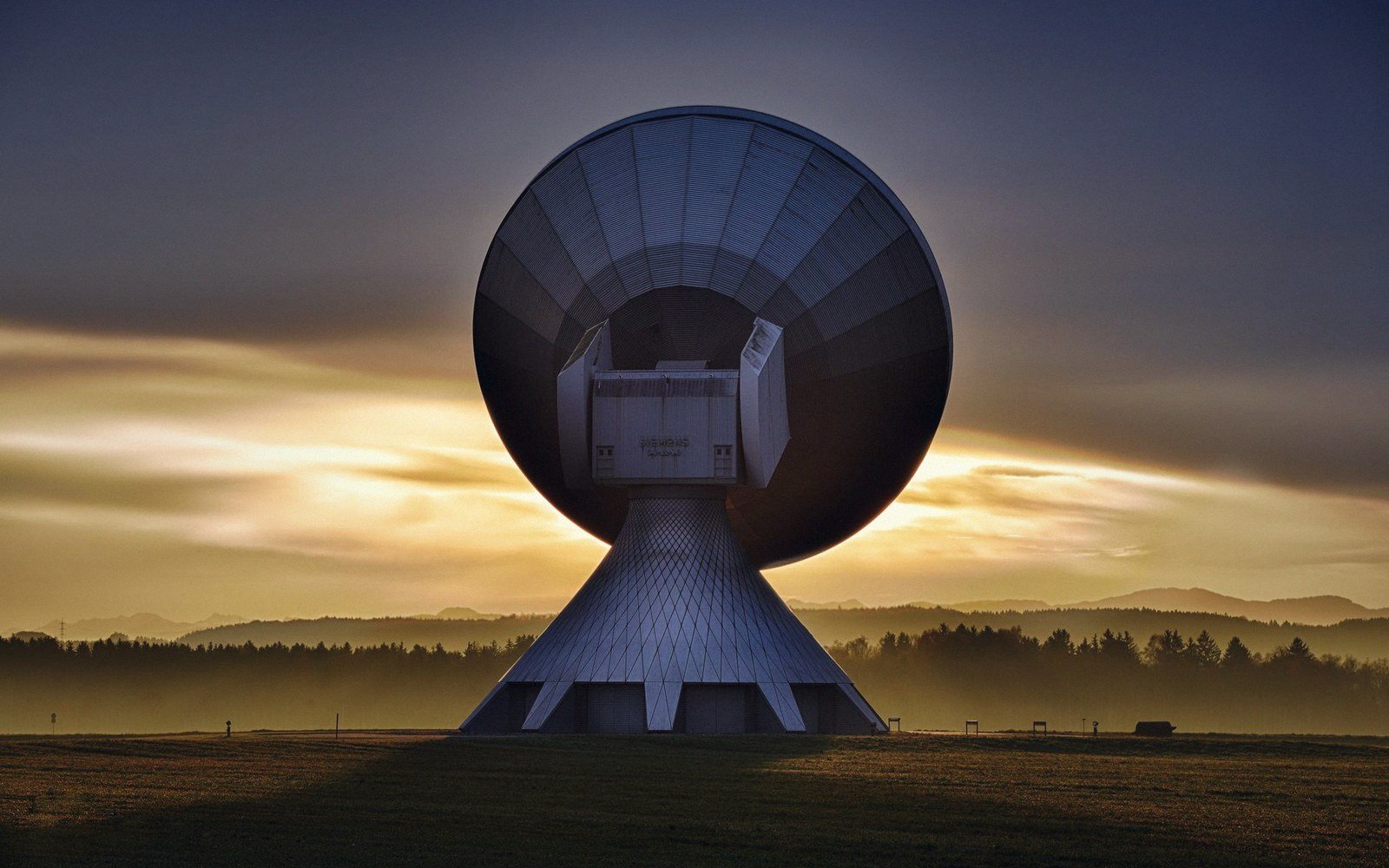
The switch follows the sun, not the clock, which is why the schedule moves through the year.
The mechanism behind the timetable
A medium-wave transmitter running at night and a medium-wave transmitter running by day are, in regulatory terms, almost different devices. The night-time transmitter leans on the ionosphere: skywaves bounce off the F layer and carry a signal hundreds of kilometres beyond the ground-wave service area. The day-time transmitter operates in a quieter sky, because the D layer forms in sunlight and absorbs those same medium-wave skywaves before they can travel far. One set of physics applies by day, another by night — and the boundary between them is neither a clock nor a calendar. It is the solar terminator, the line on the earth's surface where the sun is rising or setting at that moment.
That line moves continuously. In mid-summer at a transmitter site in central Europe or the mid-latitudes of North America, sunrise may fall before five in the morning; in mid-winter, after eight. A licence that specifies "sunset power reduction" therefore cannot name a fixed hour. Instead, the Federal Communications Commission in the United States and licensing administrations elsewhere publish annual tables of local mean sunrise and sunset times, station by station, and operators are required to make power or pattern changes within a defined window — typically a few minutes — of the tabulated time. The International Telecommunication Union's Radio Regulations underpin the same approach internationally, because interference does not respect national borders and a station in one country can ruin reception in another once skywaves are free to travel.
The practical consequence is that a transmitter may change character more than seven hundred times a year. Each change may involve switching between two licensed antenna patterns, adjusting power by a ratio of ten to one or more, or both. Directional arrays need their phasing networks verified after such transitions; a pattern that protects a co-channel station at night but is irrelevant by day must still be correct every evening when the D layer fades and the ionosphere opens again. This is not a set-and-forget situation.

At high latitudes the problem sharpens further: summer twilight can last so long that the ionosphere never fully settles into its night-time configuration, and the standard sunrise/sunset tables become an approximation to a more complex reality. In winter, the short day means operators may spend more hours running night patterns than day patterns. The transmitter follows the sun around the year because the sun governs the ionosphere, and the ionosphere governs where the signal goes.